
Greece vs Portugal Golden Visa 2026: Complete Comparison

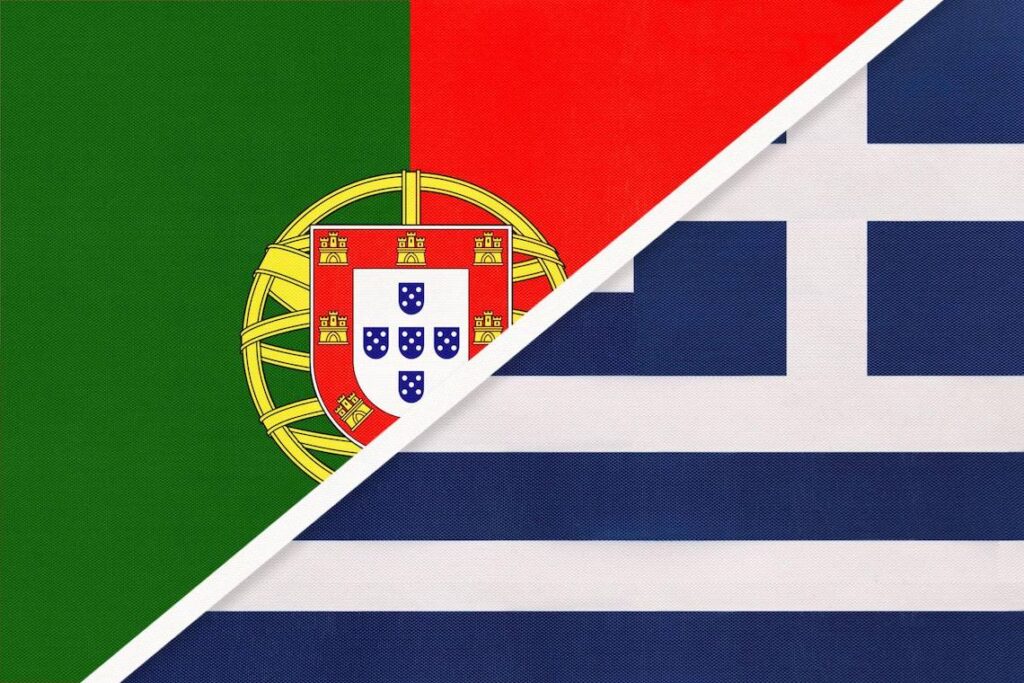
- Greece vs Portugal Golden Visa: Portugal requires EUR 500,000 in CMVM-regulated funds (no real estate since October 2023); Greece starts at EUR 250,000 for commercial conversions or EUR 400,000-800,000 for standard real estate
- Portugal requires 7 days per year in-country to maintain residency; Greece requires zero days — the most flexible residency maintenance in Europe
- Portugal offers citizenship after 5 years with A2 Portuguese language (subject to parliamentary review); Greece requires 7 years with 183+ days/year physical presence and B1 Greek language
- Portugal grants full work rights; the Greek Golden Visa does not include a standard work permit
- Greece is approximately 13% cheaper to live in than Portugal, with rental costs approximately 46% lower
The Greece vs Portugal Golden Visa comparison is the most common decision point for non-EU investors seeking European residency in 2026. The two programs have diverged materially since 2023: Portugal eliminated real estate and shifted to investment funds, while Greece doubled down on real estate with updated pricing tiers. The right choice depends on four variables — investment type preference, willingness to spend time in-country, whether work rights matter, and how serious the citizenship objective is. Advisors Portugal has guided 2,600+ families through Portugal's Golden Visa since 2019 and operates advisorsgreece.com, providing independent analysis of both programs.
What Are Greece and Portugal Golden Visa Programs?
The Greece vs Portugal Golden Visa comparison involves two of Europe’s most established residency-by-investment programs: Portugal’s ARI (launched 2012), which now requires EUR 500,000 in CMVM-regulated investment funds, and Greece’s program (launched 2013), which retains real estate as its primary qualifying route starting at EUR 250,000 for commercial conversions or EUR 400,000 to EUR 800,000 for standard property.
A Golden Visa is a residence permit issued by a country in exchange for a qualifying investment in its economy. Governments created these programs to attract foreign capital, stimulate economic growth, and create jobs. What they offer investors is a straightforward route to living in Europe without navigating the standard immigration process. The investor commits qualifying capital, meets documentation and due diligence requirements, and receives legal residency in an EU member state with Schengen Area travel rights.
Portugal’s program, launched in 2012, has issued more than 16,500 permits to main applicants and accumulated over EUR 9 billion in qualifying investment. Greece’s program launched in 2013 and has grown dramatically: Greek immigration authorities processed nearly 9,300 applications in 2024 alone, generating over EUR 2.3 billion in foreign direct investment in that year alone. Both programs are legitimate, regulated, and backed by EU institutional and legal frameworks. Both grant the same Schengen travel rights. Their differences lie in investment type, minimum capital, residency obligations, processing speed, and the path to citizenship.
The Critical Divergence: October 2023 Reforms
The October 2023 Mais Habitação reforms eliminated real estate entirely from Portugal’s Golden Visa program, redirecting it toward investment funds, cultural heritage donations, scientific research, and job creation. Greece simultaneously retained real estate and updated its tier structure in 2024, raising minimums in high-demand areas to EUR 800,000. These two decisions define the Greece vs Portugal Golden Visa choice in 2026.
Until late 2023, both programs competed on similar terms: Portugal allowed direct real estate investment, as did Greece. Portugal’s real estate route accounted for approximately 87% of total Golden Visa capital and had contributed to a housing affordability crisis in Lisbon, where property prices rose 140% over the preceding decade. The Mais Habitação reforms responded directly: real estate was eliminated as a qualifying investment category, and any fund with direct or indirect real estate exposure was simultaneously prohibited.
Greece moved in the opposite direction. Rather than removing real estate, Greek authorities updated the tier structure in 2024 to reflect demand realities, raising minimums in high-demand zones while preserving property as the primary pathway. This divergence creates a genuinely different comparison for 2026: Portugal is a fund-based program; Greece is primarily a real estate program. The choice between them begins with investment type preference.
Investment Options: Portugal
Portugal’s current Golden Visa offers five investment routes: EUR 500,000 in CMVM-registered investment funds (dominant route), EUR 250,000 or EUR 200,000 in low-density areas for cultural heritage donations, EUR 250,000 or EUR 200,000 in low-density areas for artistic production donations, EUR 500,000 in scientific research, and EUR 500,000 or more to establish a company creating ten full-time jobs. All investment capital must originate outside Portugal.
Investment Fund Route (Dominant)
EUR 500,000 minimum in a CMVM-registered Portuguese investment fund held for at least 5 years. Funds must comply with CMVM regulations, and invest at least 60% of capital in Portuguese companies. No direct or indirect real estate exposure is permitted. Verify current fund eligibility and program requirements with a qualified Portuguese immigration lawyer before committing capital.This is the most commonly chosen route since October 2023. Qualifying funds include venture capital, private equity, private credit, and diversified financial market funds operating under CMVM registration. The investment is genuine capital at market risk: EUR 500,000 is held for a minimum of 5 years, subject to fund performance. Unlike the prior real estate route, there is no tangible asset ownership; the investor holds fund units managed by a professional fund management team.
For a detailed breakdown of fund structures, eligibility criteria, and what to look for, see our Portugal Golden Visa fund investment guide.
Cultural Heritage and Artistic Production Routes
EUR 250,000 (EUR 200,000 in designated low-density areas) for donations to GEPAC-approved cultural heritage preservation projects (archaeological sites, museum conservation, palace restorations) or GEPAC-approved artistic production projects (film, theater, exhibitions). Both are non-refundable donations with no capital recovery. GEPAC pre-approval is mandatory before capital commitment.
For eligibility details, approved project types, and key considerations, see our Portugal Golden Visa cultural heritage route guide.
Scientific Research and Job Creation
EUR 500,000 in qualifying scientific and technological research institutions integrated into Portugal’s national scientific system, or EUR 500,000 or more to establish or expand a commercial company creating a minimum of 10 full-time jobs for Portuguese citizens or legal residents. Both routes require documentation of the economic activity and ongoing compliance throughout the 5-year holding period.
Investment Options: Greece
Greece’s Golden Visa retains real estate as its primary qualifying investment with a three-tier structure introduced in 2024: EUR 800,000 for high-demand areas (Attica, Thessaloniki, Mykonos, Santorini, islands over 3,100 residents), EUR 400,000 for all other regions, and EUR 250,000 for commercial-to-residential conversions and heritage building restorations only. Alternative routes include government bonds, bank deposits, and AIFs at EUR 800,000 minimum.
Real Estate Tiers (2024 Structure)
Greece’s real estate investment thresholds were updated in 2024. All figures below reflect the position as of March 2026 and are subject to legislative change. Verify current tier boundaries and property requirements with a qualified consultancy firm before committing capital.
| Tier | Area | Minimum Investment |
| Tier 1 — High demand | Attica, Thessaloniki, Mykonos, Santorini, all islands over 3,100 residents | EUR 800,000 — single unit, min 120 sqm |
| Tier 2 — All other regions | All remaining areas of Greece | EUR 400,000 — single unit, min 120 sqm |
| Special category | Commercial-to-residential conversions (full conversion must be completed before application is submitted) or heritage building restorations (restoration must be completed by year 5 of residency permit) | EUR 250,000 — no size or location restriction |
| Leasing alternative | 10-year lease/timeshare for hotel or furnished tourist residences, paid as lump sum | EUR 400,000 or EUR 800,000 matching geographic tier — not available at EUR 250,000 |
Critical restrictions apply to all Greek Golden Visa real estate. Short-term rental platforms (Airbnb, Vrbo, and similar) are prohibited: violation results in permit revocation and a EUR 50,000 fine. Properties cannot serve as registered company headquarters. Long-term rental income is permitted and can generate 3 to 5% annual yields. The EUR 250,000 special category requires active construction or restoration work with full regulatory approvals completed before application submission; it is not a straightforward property purchase comparable to the higher tiers.
Alternative Routes
Greece’s alternative non-real-estate routes include government bonds, bank deposits, Alternative Investment Funds (AIFs) at EUR 800,000 minimum, and business equity investments. Minimums are materially higher than the real estate tiers. Verify current thresholds and eligibility requirements with a qualified Greek immigration lawyer.
Investment Comparison: Greece vs Portugal Golden Visa
| Factor | Portugal | Greece |
| Minimum investment | EUR 250,000 (cultural donation) to EUR 500,000 (funds) | EUR 250,000 (special category only) to EUR 800,000 (prime areas) |
| Investment type | Funds, cultural donations, research, jobs | Real estate, bonds, deposits, AIFs, business equity |
| Real estate option | Eliminated October 2023 | Available — three-tier structure |
| Tangible asset ownership | No | Yes (real estate routes) |
| Capital recovery | Funds: yes (after 5-year hold, subject to performance); cultural/arts: no (donation) | Yes (on property sale, after holding period) |
| Capital source requirement | Must originate outside Portugal | Must originate outside Greece |
| Liquidity | Fund-dependent (7-10 years typical hold) | Property market dependent |
| Rental income permitted | N/A (no real estate) | Yes — long-term only; short-term rental prohibited (EUR 50,000 fine) |
Processing Times and Application Timelines
Greece currently processes Golden Visa applications in 8 to 12 months, a material competitive advantage over Portugal’s historical 18 to 24 month timeline. AIMA’s 2025 digitalisation reforms, including automatic biometric scheduling within 30 to 90 days and expanded processing capacity, aim to close this gap, though delays remain likely for applications submitted before reforms fully take effect.
Portugal’s application process runs through AIMA (Agência para a Integração, Migrações e Asilo). Historically, AIMA’s review of documents and biometric data alone has taken up to eight months, with administrative processing extending the total to 20 to 24 months. A programme of structural reforms announced in 2025, including full digitalization of the application workflow, automatic biometric appointment scheduling within 30 to 90 days, acceptance of untranslated English, French, and Spanish documents, and expansion of biometric collection locations nationwide, targets resolution of all pending applications by December 2025. For applicants submitting in early 2026, improved timelines are plausible but not guaranteed.
Portugal AIMA processing timelines are subject to change. The 20 to 24 month historical range reflects pre-reform conditions; 2025 reforms target significantly faster throughput. Verify current processing times with AIMA or a qualified Portuguese immigration lawyer before making decisions based on timeline.
Greece’s immigration authorities process applications within 8 to 12 months as a general baseline. This speed has become a significant factor for time-sensitive investors. Both countries require in-person submission of biometric data; plan for at least one visit to the country during the application process. Both accept applications through local consulates in the applicant’s home country for initial stages, with the biometric appointment completed in-country.
| Processing Metric | Portugal | Greece |
| Typical total timeline | 20-24 months (improving) | 8-12 months |
| Biometric appointment | In-country required | In-country required |
| Document language | English/French/Spanish now accepted | Translated documents required |
| Application digitization | Full digital workflow (2025) | Partially digital |
| Backlog status | Active clearance programme underway | Limited backlog reported |
Residency Requirements: How Much Time Do You Actually Need?
The residency requirement gap between Greece and Portugal Golden Visa programs is the most operationally significant difference for global investors: Portugal requires 14 days in the first two-year period (averaging 7 days/year); Greece requires zero days at any point to maintain permit validity. However, Greek citizenship requires 183+ days/year for 7 years, meaning the zero-day rule applies to residency maintenance only, not to citizenship qualification.
Portugal: Seven Days Per Year
Portugal requires a minimum of 14 days presence during the first 2-year permit period, and 7 days per year in each subsequent period. These are minimum requirements subject to change. Absences documented through travel records, flight bookings, or accommodation receipts may be requested on renewal. Verify current requirements with AIMA before application.
Portugal’s formula is: 14 days across the first two years, then 7 days annually thereafter. This is the lowest fixed presence requirement in Western Europe for a programme that leads to citizenship eligibility. The visa remains valid. The seven-day requirement also creates a documented connection to Portugal that supports the eventual citizenship application.
Greece: Zero Days Required for Residency
Greece imposes no minimum stay requirement to maintain residency permit validity. The investor can obtain a Greek residence permit and never return to Greece: the permit renews on schedule as long as the qualifying investment is maintained. This is the most flexible residency maintenance structure in Europe. For global investors managing multiple residencies, or investors who want the security of EU residency without any obligation to be physically present, the Greek structure has no equivalent.
The Greek Golden Visa zero-day residency maintenance rule applies to permit validity only. Greek citizenship requires 7 years of continuous residency with 183+ days per year of physical presence in Greece, plus B1-level Greek language proficiency and documented integration. Investors pursuing citizenship through Greece cannot rely on the zero-day maintenance rule. Verify current citizenship requirements with a qualified Greek immigration advisory firm.
Visa Validity and Renewal Cycles
Portugal operates on a 2+2+2 year renewal cycle: the initial permit is valid for 2 years, the first renewal adds 2 years (years 2 to 4), and the second renewal adds 2 years (years 4 to 6). Permanent residency eligibility arrives at the 5-year mark during the second renewal period. This means two administrative renewal cycles before permanent residency. Greece operates on a 5-year renewal cycle: initial permit valid for 5 years, renewals valid for 5 years each. Fewer administrative cycles mean less frequent paperwork and fewer interactions with immigration authorities for investors managing multiple residencies globally.
Which Is Better for Citizenship: Greece vs Portugal Golden Visa?
Portugal’s citizenship pathway is materially more accessible: 5 years of legal residency with A2 Portuguese language proficiency and minimal physical presence, compared to Greece’s requirement for 7 years of continuous residency with 183+ days/year physical presence and B1 Greek language proficiency. For investors whose primary objective is an EU passport, the Greece vs Portugal Golden Visa comparison resolves clearly in Portugal’s favour, subject to the current parliamentary review of Portugal’s citizenship timeline.
Portugal’s Citizenship Route
After 5 years of legal residency, Portugal allows applications for permanent residency and subsequent Portuguese citizenship. Requirements include A2-level Portuguese language proficiency (basic conversational ability, achievable for most learners within 6 to 12 months of study), a civic knowledge assessment, and a clean criminal record. The practical timeline: 5 years as a Golden Visa holder with 7 days/year minimum presence, then application for permanent residency and citizenship. An EU passport within approximately 6 years of initial application approval is a realistic outcome for well-prepared applicants.
Portugal’s Constitutional Court upheld an extended citizenship residency timeline in December 2025. This legislation must return to Parliament for final approval. A draft law published in June 2025 proposes increasing the residency requirement from 5 to 10 years (7 years for nationals of Portuguese-speaking countries). Applications submitted before June 19, 2025 may be grandfathered under the original 5-year rule if transitional provisions are included. Monitor parliamentary developments and verify current requirements with a qualified Portuguese advisory firm.
Greece’s Citizenship Route
Greek citizenship requires 7 years of continuous residency with documented physical presence of 183+ days per year in Greece, B1-level Greek language proficiency, and demonstrated integration into Greek society (community ties, civic participation, and documented presence). Greek citizenship is not awarded on a timeline alone: immigration authorities assess genuine integration. A Greek Golden Visa investor who has maintained zero-day residency cannot qualify for Greek citizenship without a material change in lifestyle and physical presence. Verify current requirements with a qualified Greek advisory firm.
The practical implication of the Greek citizenship requirements is that investors pursuing citizenship through Greece must commit to substantially relocating, learning Greek to an intermediate conversational level, and building documented ties to Greek society. This is a fundamentally different commitment than Portugal’s accessible citizenship pathway. For investors whose objective is an EU passport, this distinction matters more than any other aspect of the Greece vs Portugal Golden Visa comparison.
Citizenship Comparison
| Citizenship Factor | Portugal | Greece |
| Minimum residency period | 5 years (under parliamentary review — may extend to 10 years) | 7 years continuous residency |
| Physical presence for citizenship | 7 days/year minimum (existing GV requirement) | 183+ days/year for the full 7 years |
| Language requirement | A2 Portuguese (basic) | B1 Greek (intermediate) |
| Integration assessment | Civic knowledge test | Demonstrated community ties and documented integration |
| Dual citizenship | Yes — no renunciation required | Yes — no renunciation required |
| EU passport | Yes — full EU/EEA mobility for living and working in 27 member states | Yes — full EU/EEA mobility |
| Practical citizenship accessibility | High (low presence, accessible language requirement) | Low (full relocation + intermediate language effectively required) |
Benefits: Family, Healthcare, Travel, and Cost of Living
Greece vs Portugal Golden Visa programs deliver comparable family inclusion benefits (spouse, dependent children, parents), access to public healthcare and Schengen Area travel, and safety rankings among Europe’s best. The material lifestyle difference is cost: Greece is approximately 13% cheaper to live in than Portugal overall, with rental costs approximately 46% lower. Portugal provides work rights; Greece does not.
Family Inclusion
Portugal covers the primary applicant, spouse (including same-sex spouses), dependent children up to age 25 if enrolled in full-time study, and parents of the primary applicant or spouse with financial dependency documentation. Greece covers the primary applicant, spouse (including same-sex spouses following 2024 legislative changes), dependent children up to age 24 if unmarried and studying, and parents or parents-in-law. Family members in both programs receive the same permit validity period as the primary applicant and the same Schengen travel rights.
Healthcare and Education
Portugal operates a public healthcare system (Serviço Nacional de Saude, SNS) accessible to all residents, with private healthcare available at costs significantly below US or UK levels. Portugal has a reputation advantage in English-language provider availability, particularly in Lisbon and Porto. Greece operates a comparable public system (EOPYY), with quality varying by region and stronger private options in Athens and major tourist centres. Both countries rank well on healthcare access and cost-effectiveness relative to other Western nations. University education is accessible in both countries, typically at lower cost than English-speaking countries, with international private schools in major cities for school-age children.
Schengen Travel and Work Rights
Both programs grant visa-free travel throughout the 29 Schengen Area countries for up to 90 days in any 180-day period. This includes visa-free business travel, personal travel, and short-term residency across Austria, Belgium, Bulgaria, Croatia, Czech Republic, Denmark, Estonia, Finland, France, Germany, Greece, Hungary, Iceland, Italy, Latvia, Liechtenstein, Lithuania, Luxembourg, Malta, Netherlands, Norway, Poland, Portugal, Romania, Slovakia, Slovenia, Spain, Sweden, and Switzerland.
The critical work rights distinction: Portugal Golden Visa holders are granted Portuguese residence permits that allow them to live and work in Portugal without additional authorisation. The Greek Golden Visa grants residency and Schengen travel rights but does not automatically grant a standard employee work permit in Greece. For investors who want to work in their residency country, Portugal is the only option between the two.
Cost of Living
| Cost Metric | Portugal | Greece |
| Overall cost of living | Portugal approximately 13% higher than Greece |
| Single person monthly (excl. rent) | EUR 1,500-1,800 (Lisbon) | EUR 800-1,200 (Athens) |
| Monthly rent — 1-bed apartment | EUR 900-1,200 (Lisbon), EUR 500-800 (provincial) | EUR 500-800 (Athens), EUR 300-500 (provincial) |
| Total monthly (single, major city) | EUR 2,400-3,000 (Lisbon) | EUR 1,300-1,800 (Athens) |
| Healthcare (private) | Affordable vs US/UK — EUR 50-150/month typical |
| Lifestyle premium | Stronger infrastructure, English services, W. European connectivity |
Who Should Choose Greece and Who Should Choose Portugal?
The Greece vs Portugal Golden Visa decision resolves on four factors: investment type preference (funds vs real estate), physical presence willingness (7 days/year vs zero), citizenship objective (accessible vs demanding), and work rights requirement (Portugal yes, Greece no). Neither program is objectively superior; they serve genuinely different investor profiles.
Portugal is the right choice if:
Your investment strategy favours regulated funds with professional management over direct property ownership. You are building toward EU citizenship and want the most accessible pathway: 5 years with 7 days/year presence and A2 Portuguese language (subject to parliamentary review). You need or want the right to work in Portugal. You value stronger English-language infrastructure, institutional connectivity to Western European business centres, and Lisbon or Porto’s established international communities. You can commit EUR 500,000 to a 5-year fund investment and are comfortable with market risk on that capital rather than tangible asset ownership. You are building a long-term strategic EU platform, not simply a residency document.
To better understand fund selection, structure, and performance differences, review the Portugal Golden Visa funds 2026 guide, learn how to assess options in How to evaluate Portugal Golden Visa funds, and explore sector exposure in the Portugal Golden Visa fund sectors guide.
Greece is the right choice if:
You want real estate ownership as a tangible, controllable asset. You require the fastest possible residency processing (8 to 12 months versus Portugal’s improving but historically longer timeline). Zero minimum physical presence for residency maintenance is a priority: you want the security of EU residency without any obligation to be present in Greece. The cost of living differential matters to your lifestyle planning: Greece is approximately 13% cheaper overall and approximately 46% cheaper on rent. You do not require Greek work rights and are not pursuing Greek citizenship (which requires 183+ days/year for 7 years and B1 Greek language).
Key Trade-offs Summary
| Factor | Portugal | Greece |
| Work rights | Yes — full employment rights | No standard work permit |
| Investment type | Funds, cultural donations, research, jobs | Real estate (primary), bonds, AIFs |
| Citizenship accessibility | High (5 years, 7 days/year, A2 Portuguese) | Low (7 years, 183 days/year, B1 Greek) |
| Physical presence for residency | 7 days/year minimum | Zero days required |
| Processing speed | Improving — 20-24 months historically | 8-12 months typical |
| Renewal cycle | 2+2+2 years (2 renewal cycles) | 5+5 years (fewer cycles) |
| Cost of living | Higher — EUR 2,400-3,000/month in Lisbon | Lower — EUR 1,300-1,800/month in Athens |
| Tangible asset ownership | No | Yes (real estate routes) |
| Minimum investment (lowest route) | EUR 250,000 (cultural donation) | EUR 250,000 (special category only) |
The Greece versus Portugal Golden Visa comparison ultimately resolves on what kind of investment you want to hold, how important citizenship is to your objectives, and whether you need work rights in your residency country. Advisors Portugal has guided 2,600+ families through Portugal’s Golden Visa since 2019 and operates advisorsgreece.com to provide independent analysis of the Greek programme. We do not push clients toward either programme based on commission structure; we provide honest comparison and recommend the pathway that genuinely fits your financial profile, residency objectives, and timeline. Both programmes require professional immigration legal counsel, cross-border tax advice, and thorough investment due diligence — regardless of which you choose.
Frequently Asked Questions
Ten Q&A pairs on the Greece vs Portugal Golden Visa comparison: work rights, language requirements, property maintenance, citizenship outcome, Schengen travel, rental income, rejection, fund restrictions, tax implications, and residency vs citizenship distinction.
Portugal grants full work rights: Golden Visa holders and their included family members receive Portuguese residence permits that allow employment without additional authorisation. Greece does not: the Greek Golden Visa provides residency and Schengen travel rights but does not include a standard employee work permit. For investors who need to work in their residency country, Portugal is the only option between the two programmes.
No language requirement for obtaining the initial residence permit in either country. For citizenship: Portugal currently requires A2-level Portuguese language proficiency and a civic knowledge assessment. Greece requires B1-level Greek language proficiency and demonstrated integration. Portugal’s language requirement applies at citizenship application stage; the citizenship timeline itself is under parliamentary review following the Constitutional Court’s December 2025 ruling.
Yes. Maintaining the qualifying investment is a condition for renewing the Greek Golden Visa. Selling the property before meeting renewal or permanent residency conditions risks permit revocation. If you wish to sell and maintain residency, you must reinvest in another qualifying property or route that meets current threshold requirements. Plan the hold period carefully before acquiring the qualifying asset.
Portugal offers citizenship after 5 years of legal residency with minimal physical presence and A2 Portuguese language, a realistic outcome for investors not living in Portugal full-time. Greece requires 7 years of continuous residency with 183+ days/year physical presence and B1 Greek language, effectively requiring full relocation. For investors whose objective is an EU passport without relocating, Portugal is the more accessible pathway.
Yes, for travel. Both Portuguese and Greek residence permits grant visa-free access across all 29 Schengen Area countries for up to 90 days in any 180-day period. The distinction is work rights and long-term settlement rights: Golden Visa holders can work in Portugal but not in Greece, and can only establish permanent residence in another EU country after obtaining citizenship from their residency country (5 years for Portugal, 7 years for Greece). Full EU mobility for living and working anywhere in the EU requires citizenship, not just residency.
Long-term rental is permitted and many investors generate 3 to 5% annual yields from their qualifying Greek properties. Short-term rental platforms (Airbnb, Vrbo, and similar) are explicitly prohibited for Golden Visa properties. Violation results in permit revocation and a EUR 50,000 fine.
Rejections are relatively rare but occur in four main scenarios: fraudulent documentation, inability to verify the source of investment funds (AML failure), criminal background concerns, and investment capital that does not meet qualifying criteria. Applications are independent between the two countries: a Greek rejection does not bar a Portuguese application and vice versa. If rejected, applicants typically have the right to reapply with corrected documentation. Professional immigration legal representation materially reduces rejection risk in both programmes.
Yes. Fund investments must be registered with CMVM and formally designated as qualifying for the Golden Visa programme. Investors cannot select any CMVM-registered fund at their discretion; the fund must specifically meet Golden Visa eligibility criteria including the 60% Portuguese company investment requirement and zero real estate exposure. Use CMVM-verified, Golden-Visa-approved funds only. Advisors Portugal evaluates 80+ qualifying CMVM-regulated funds independently.
If you spend 183+ days per year in either country, you become a tax resident and must declare worldwide income to that country’s tax authority. Both Portugal and Greece have tax treaties with the US and many other countries preventing double taxation. Portuguese fund investors benefit from favourable fund distribution tax rates (currently approximately 10% for residents). Tax implications are highly jurisdiction-specific; consult a cross-border tax advisor before making investment or residency decisions.
Residency is legal permission to live in a country; citizenship is formal membership in that country with all accompanying rights including the right to vote, sponsor family members under different visa categories, and hold a national passport valid for 190+ countries. A residence permit does not automatically become citizenship: you must apply after the required residency period and meet language and integration requirements. A Greek or Portuguese residence permit grants Schengen travel rights; citizenship grants an EU passport with unrestricted right to live and work in all 27 EU member states indefinitely.
References and Regulatory Sources
- IRS Form 8621, PFIC Reporting
- FATCA
- FinCEN 114, FBAR
- IRC §4975, Prohibited Transactions
- CMVM (Comissão do Mercado de Valores Mobiliários)
- ESMA (European Securities and Markets Authority)
- Banco de Portugal
- INE (Instituto Nacional de Estatística)
- WTTC (World Travel & Tourism Council)
- APREN (Associação Portuguesa de Energias Renováveis)
- Portugal NECP 2030 (National Energy and Climate Plan)
- S&P Global Ratings
- Portuguese Tax Authority (AT)
- Portuguese Parliament
- Greek Tax Authority
- Greek Immigration Authority (official)